
Morocco On Bike....An Adventure of a Lifetime

Updated: Mar 12

Hello! My name is Darcy, the owner of Thrive Outside, adventure addict, nature lover and passionate about getting people exploring in the outdoors. Although this blog post isn't specifically about Thrive Outside, I wanted to share a recent personal adventure with the hopes it is an interesting read, may inspire others to plan an experience out of the ordinary and gives people an insight into my 'why' as an Outdoor Educator and business owner.
.....best read sipping a coffee outside.

Why Morocco and why on a bike?
For a while, I’d been wanting to go on an adventure that felt different from the ones I’d done before. Typically, I stay within Australia travelling to places like Tasmania or Kosciuszko National Park. Partly because it’s more affordable, but also because it’s comfortable and familiar. Same country, same culture, same language, same currency and familiar food.
But I knew it was time to step outside that comfort zone. I wanted an experience that would immerse me in a completely new culture and landscapes, whilst still having an adventure. Travelling on bike felt like the best option. Friends who’ve travelled overseas often talk about how much richer and authentic their experiences were when they moved through a place slowly, pedalling instead of rushing from one destination to another. There was more to this adventure.....
I strongly believe in growth through adversity and challenge, and that putting yourself in situations that stretch you builds strong confidence and resilience. In the Shinto religion, an indigenous Japanese belief system, there is a ritual called Misogi. Traditionally, it involves committing to one defining challenge each year....something that ignites both fear and excitement. A challenge you’re not entirely sure you’ll be able to complete.
This traditional practise aligns closely with my work as an outdoor educator. I take young people on challenging experiences like multi-day bushwalks, rock climbing and abseiling. Through those experiences, I see real growth, increased confidence, resilience and students walking away with a new belief in themselves. This trip felt like an opportunity to practise what I preach and take on my own challenge.
After some research, I stumbled across a bikepacking route in Morocco called the Route of Caravans. It immediately stood out. It felt remote, adventurous and culturally rich...exactly what I was looking for. With the trip planned for early February, temperatures in lower elevations would sit mid 20°C, while the High Atlas Mountains would likely still have snow. By the end of the ride, the snow should have melted enough to ride through, but there was still some uncertainty. I was willing to roll the dice on that, and truthfully the idea of riding through a bit of snow sounded pretty appealing!
Whenever I set a goal, I’ve found that the best way to make it real is to start talking about it. Once it leaves my head and enters the real world, I’m far more likely to follow through. The reactions were mixed. Some though I was crazy (...mum and dad), most were excited. One friend was so excited he decided he wanted to join the adventure....

Meet Sam!
Another adventure lover and always up for a challenge. Having a second person made the trip safer and no doubt more enjoyable. Sam didn’t have any bikepacking experience and infact didn't even own a touring bike yet! But anyone who knows Sam would back me in saying he brings an abundance of useful skills to any trip, and more importantly, a huge amount of enthusiasm.
Over the course of the next 10ish months we built our bikes up, studied the map and researched the area, and even did a shakedown bike trip on the Goldfields Track in Victoria to test out the new bikes and bike packing bags before the big adventure
And just like that, the crazy idea started turning into something real.
The Route of Caravans
Reflecting on the trip while writing this blog, I’ve realised just how much happened over the course of the ride. I would love to outline every single moment, but that would quickly turn this into a short novel. So instead, I’m going to break the journey into three main sections: the Anti-Atlas, the Sahara Desert, and the High Atlas Mountains. Each one felt completely different, with its own challenges, landscapes and experiences...almost like three separate adventures rolled into one.
The Anti Atlas - Day 1 to 8
The route started in the small town of Tiznit. Before rolling out, we treated ourselves to a double breakfast of omelettes and pancakes in anticipation of a hard day of riding ahead.
The ride didn’t begin in the most glamorous way, we were literally peddling through the town's rubbish dump and carefully watching for the broken glass littering the track. Not exactly the postcard start you imagine. Soon enough the scenery shifted and we began our ascent into the Anti-Atlas Mountains passing through small villages as the road gradually climbed. That afternoon we pulled up at a muddy step beside the road, with an epic view stretching out in front of us and the sound of the Oued Massa river flowing below.
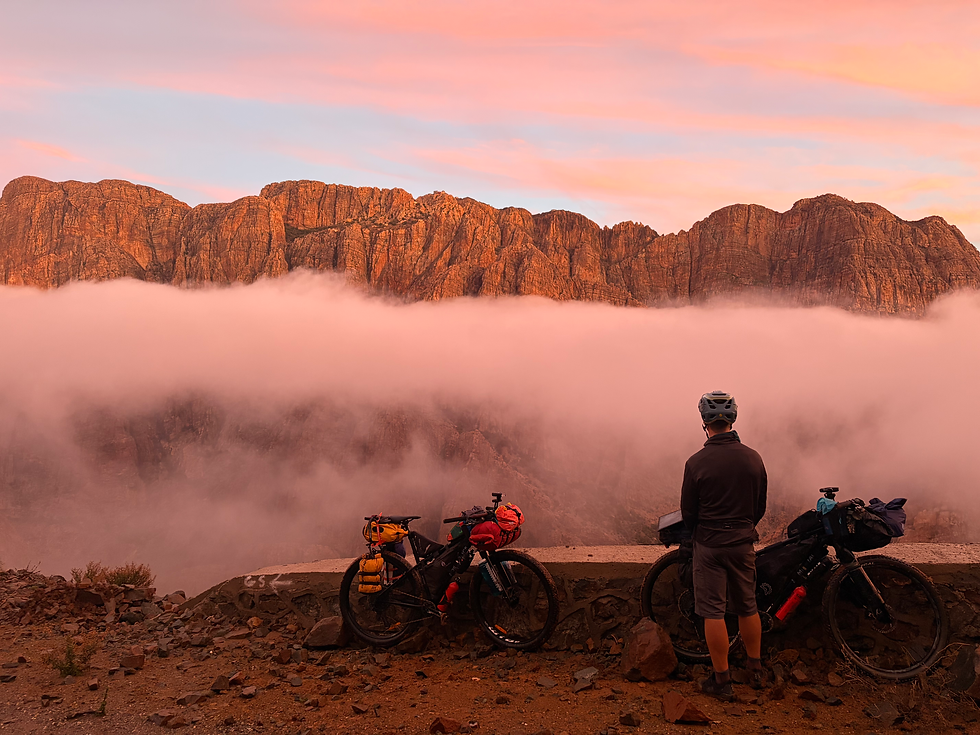
Overnight heavy rain hit our tents, but by morning it had eased to a light drizzle. We started riding and slowly climbed above the clouds watching the inversion as the sun rose. If you looked closely at the cliff tops, you could spot small pink buildings scattered in the most unlikely places. It was honestly one of the best views of the entire trip, words and photos don't do it justice.
As the days rolled on in the Anti-Atlas, moments like that became surprisingly common. We crossed multiple mountain ranges and rode through deep gorges lined with villages. Locals were often excited to see us. The local dogs...not so much. We ate great food, stayed in a few auberges along the way, and settled into a riding rhythm. Rather than recounting every detail, here are a few standout moments:

Playing soccer with local kids
Helping push-start a car
Pumping up a young boy’s bike tyre who then thanked us by showing us a great wild camp to stay the night
Getting woken up in the middle of the night by a barking dog… who later returned with a friend to continue the job of keeping Sam awake all night
One afternoon, after helping a group of men load bricks onto a truck, they insisted we join them for tea and a tajine on the side of the road. It was a small gesture, but it said everything about the generosity we kept encountering. On one of the hardest days we rolled into a village surrounded by snowy peaks, exhausted and low on food, only to find the café/tuckshop we were counting on for a snack and dinner was closed. Morale dropped quickly. After asking a local man for water, he kindly filled our bottles at his home. Soon after, another man waved us into what looked like a makeshift hut of tarps and sticks. Inside was a café filled with men drinking tea and watching soccer. He made us cafe lattes, served cake and even gave us fresh bread from his house.

The Anti-Atlas kicked our butts. It took eight days to reach Foum Zguid, marking the end of the mountains and the beginning of the Sahara. It was hard, and at times definitely “type 2 fun” (not enjoyable in the moment, but rewarding in hindsight). But we were in the groove now....wake up, ride, find somewhere to sleep, repeat.
What stood out most in this first section of the trip was the kindness of the Moroccan people. From day one,
people offered directions, water and help wherever they could.
The Sahara Desert - Day 9 to 11
After a tough eight days through the Anti-Atlas, we decided it was time to ease off the pedals for at least for one day. A slow morning in Foum Zguid was exactly what we needed. By the time we got up, resupplied water and finally rolled out of town it was already 11am.

The plan was 60 to 70 kilometres of mostly flat desert riding and let to the body recover.
But the Sahara had other ideas.
With a strong tailwind behind us, we pretty well flew across the desert! After days of climbing and fighting headwinds in the mountains, it felt incredible to move quickly with minimal effort. Knowing the tailwind wouldn’t last forever, we decided to make the most of it. What was meant to be a shorter day turned into a much bigger one. It felt really good to be making good progress again.


The Sahara was beautiful in a completely different way to the mountains we’d just left behind. There were patches of soft sand that slowed you to a crawl, sections of sharp rock threatening to slice a tyre open and an overwhelming vastness in the landscape stretching in every direction.
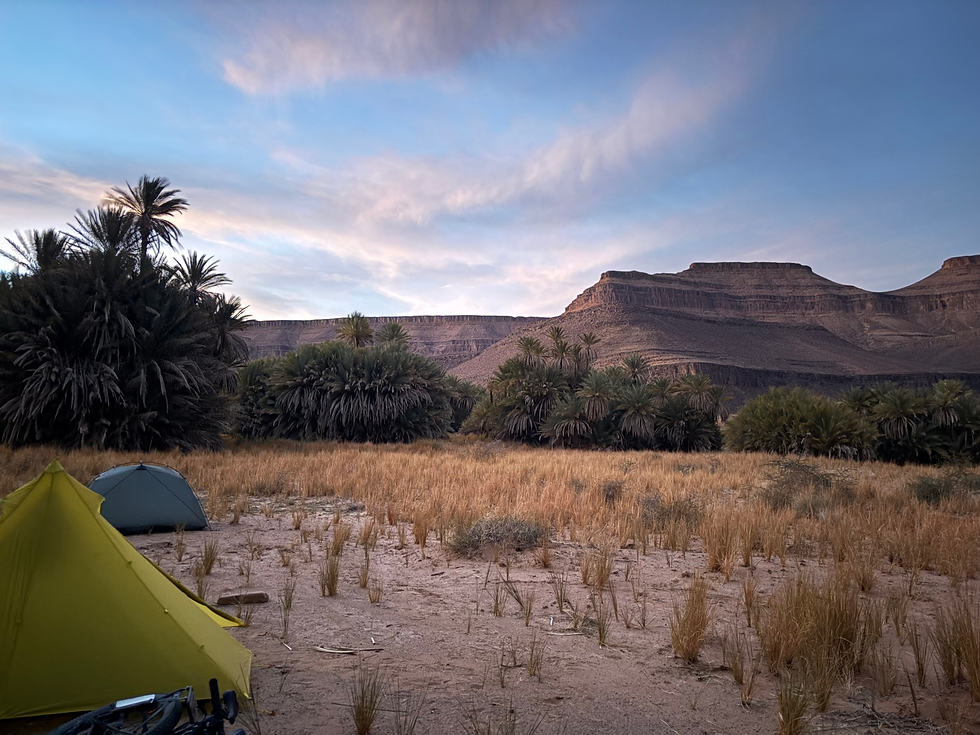
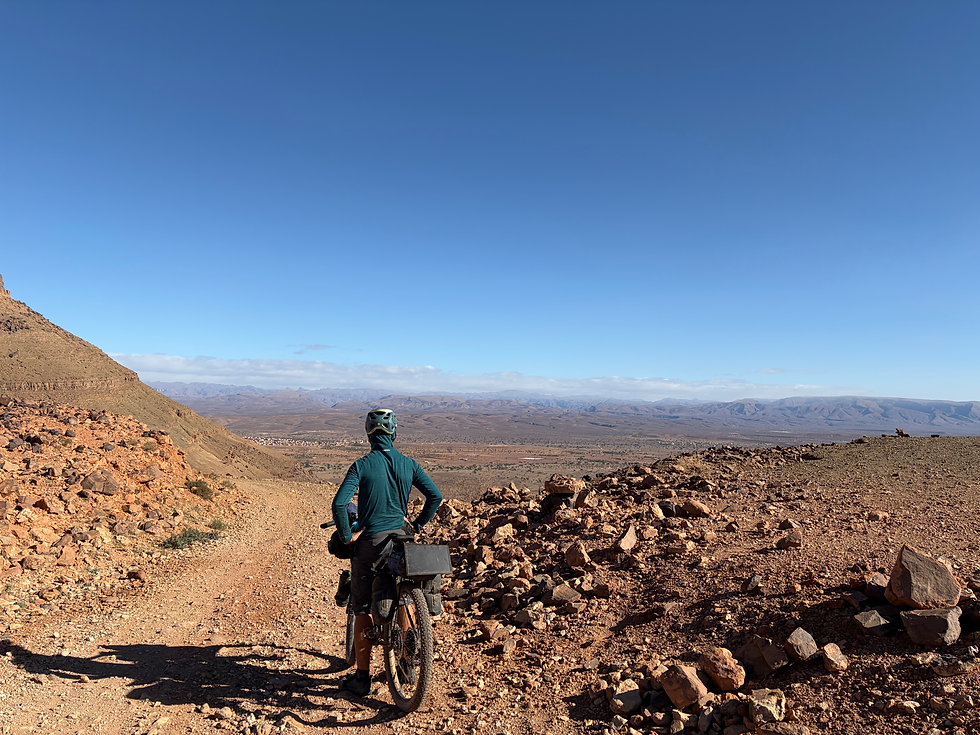
We stopped at a random roadside restaurant that seemed to appear out of nowhere. Omelette and mint tea for lunch, simple and perfect, before pushing on once more. That evening we found a wild camp beside a lonely tree in a sandy riverbed. It ended up being one of my favourite camps of the entire trip. While at this wild camp, an Addax (Moroccan antelope) walked straight passed us. Since being home and reunited with Google, I now know that we were lucky to see an addax as it is critically endangered with under 100 estimated to be in the wild.
The following days we really started to put the hammer down. Riding over 100 kilometres each day felt strong and steady. For the first time, it felt like we were truly covering ground. As we did, the uncertainty and nerves that had lingered early in the trip due to the unknown began to fade.
We passed through towns Tagounite, Zagora with a mix of accomodation and wildcamping along the way. Finally reached a town called Nkob which marked the end of the desert and the fast flat riding...it was time for the anticipated High Atlas.
The High Atlas - Day 11 to 16
Leaving Nkob, the climbing began almost immediately, it felt like we were riding uphill forever. To manage it mentally, we broke the climb into bite-sized chunks...200 metres of elevation at a time and then a short break. A sip of Hydralyte, half a Snickers bar, then repeat. It wasn’t pretty, but it worked. Eventually, we reached the tiny village of Tagemount. We stayed in the most basic accommodation of the trip, a thin mattress on the floor and a bucket shower, but the owner and his son Mohammed welcomed us warmly. That night’s tajine absolutely hit the spot after such a big day on the saddle.
The next morning delivered one of my favourite sections of the entire ride, 40 kilometres of mostly downhill weaving through the landscape toward Kelaat M’Gouna. It felt effortless! We stopped as usual at a café for food and coffee, and it set the tone for the days ahead. From there, we slowly ascended through Dades Gorge. It’s a popular tourist hotspot, lined with cafés and restaurants all the way up, and we definitely took advantage of that. After some intense days in the desert, the slower pace riding felt good.
On one of our final days, we planned to stay at an auberge before the biggest climb of the trip. When we arrived, it was closed. With not much food left and not keen to turn back, we decided to camp out front. Thankfully, we’d had a late lunch earlier, so skipping dinner wasn’t the end of the world. As night settled in, two men approached us and told us to leave. At first it felt like a negative interaction, but it quickly turned positive. Through Google Translate, they explained they were worried about us getting cold. We were camped at around 2,200 metres above sea level and temperatures would drop well below zero overnight. We assured them we’d be okay, and they eventually left, but the concern they showed stuck with me, as they really care about us.

The next day we climbed to the highest point of the trip...3,000 metres. Snowy peaks stretched endlessly in every direction. The road was lined with large walls of snow and we where glad to be riding up in good weather as a few days earlier the road was closed and snow fall was heavy.
On the way up, we passed a broken-down car with its engine hanging loose from the mounts. Two Moroccan men somehow wired it back together, borrowing my pliers to finish the job. Proper bush mechanics. After a long descent, we rolled into Imilchil, marking the end of the Route of Caravans. As usual, we celebrated with coffee, tajine, and the warm hospitality of another welcoming auberge host.
Our final day turned out to be one of the toughest of the trip. Part of it was the weather conditions, but a lot of it was mindset. Sam and I both felt like the ride was basically finished. In our heads, all that remained was a long downhill run into Beni Mellal. Over the roughly 130 kilometres to the finish there was still about 3,000 metres of climbing left. To make things harder, we spent most of the day riding straight into a strong headwind, with gusts around 60–70 km/h. Riding through patches of snow with the wind chill on our faces made it even tougher. Eventually we rolled into the town of Taglft just as a large storm was building in the distance. We ducked into a small café to regroup and quickly realised reaching Beni Mellal under our own power was becoming unlikely.

The café owners kindly pointed us toward a nearby taxi stand, something we never would have found without their help. That’s where we met Mustapha our friendly taxi driver. We strapped our bikes to the roof of his taxi with some cord I’d been carrying and jumped in. Almost the moment the doors closed, the rain started pouring. As we drove along the narrow mountain roads, waterfalls were spilling down the cliffs and onto the road. Watching the storm roll through confirmed we’d made the right call.
We arrived in Beni Mellal warm, dry and proud of how far we’d ridden. And after sixteen days of mostly couscous and tajine, a pizza to celebrate this epic adventure tasted amazing.
Recap
Looking back on the ride now, it feels bigger than just the kilometres we covered.
We started in Tiznit and rode straight through a rubbish dump. From there it was eight days of climbing through the Anti-Atlas...landslides, barking dogs, sunrise above the clouds and small villages . Onto the Sahara where tailwinds carried us further than planned and camels and addax (antelope) roamed the wide stretched landscapes. And finally the High Atlas, with long climbs, cafes, awesome people, snowy peaks and big descents.
On paper, it was a bike ride across Morocco. In reality, it was so much more than that.
It was learning to sit with discomfort, headwinds, uncertainty, closed auberges and long climbs that felt never-ending. It was discovering that “type 2 fun” really is worth it. It was the rhythm and simplicity of waking up knowing that all I have to do is ride my bike. And more than anything, it was the generosity of people.
The men who insisted we join them for tea on the side of the road. The café owner that gave us bread from his home. The locals concerned we’d freeze whilst camping in the High Atlas. The bush mechanics wiring an engine back together on the side of the road. The kids wanting to kick a soccer ball, and the constant smiles and waves.
Adventure strips things back. It removes comfort, predictability and routine. And in doing that, it creates space for connection, perspective and growth. When you’re slightly outside your comfort zone, you notice more. You rely on connections with others and you appreciate simple things a whole lot more.
This trip reminded me why I believe so strongly in challenge and intentional discomfort. Not because it’s always enjoyable in the moment, but because how you change for the better on the other side.
16 days....mountains, desert, sore bums, and a lot of mint tea. Truly an adventure of a lifetime.
Thanks for reading!
Darcy

Comments